July 2026: Crypto quietly won.
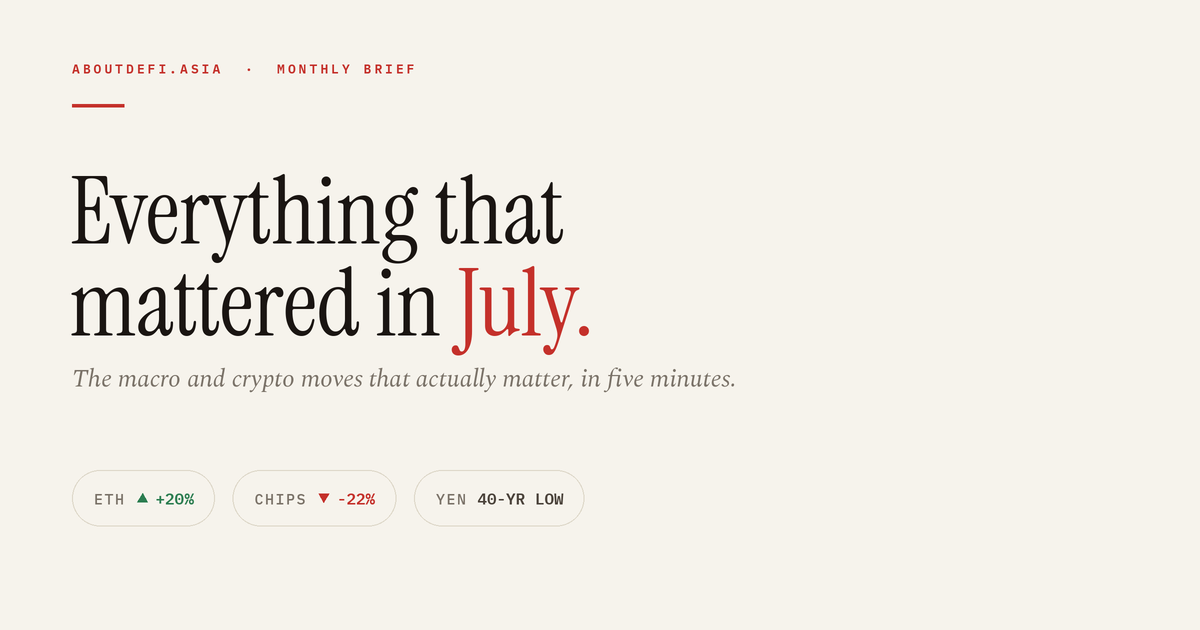
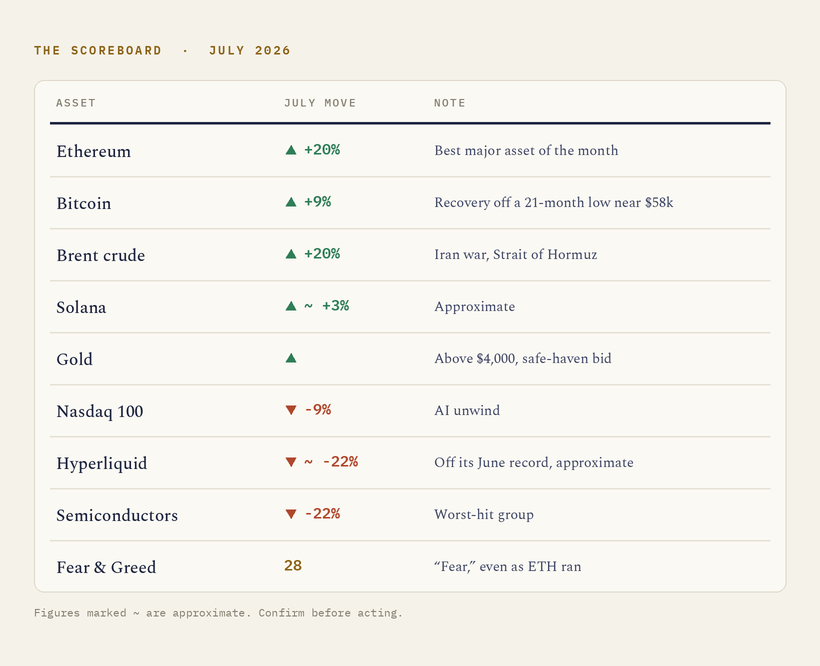
Ethereum rose about 20% and Bitcoin about 9% in July while AI chip stocks fell roughly 22%. For the first time in 2026, the AI trade that carried the whole market cracked, and crypto caught the spillover. But read this before you get excited: the bounce was narrow, sentiment stayed fearful all month, and the two forces that actually run this market, a hawkish Fed and a fragile yen, both point the same way. This is a market to respect, not chase.
If you only read this
- Cheap money is not coming back in 2026. The new Fed is biased to hike, not cut. Any plan, fundraise, or budget quietly built on rate cuts is now wrong. Re-check your assumptions.
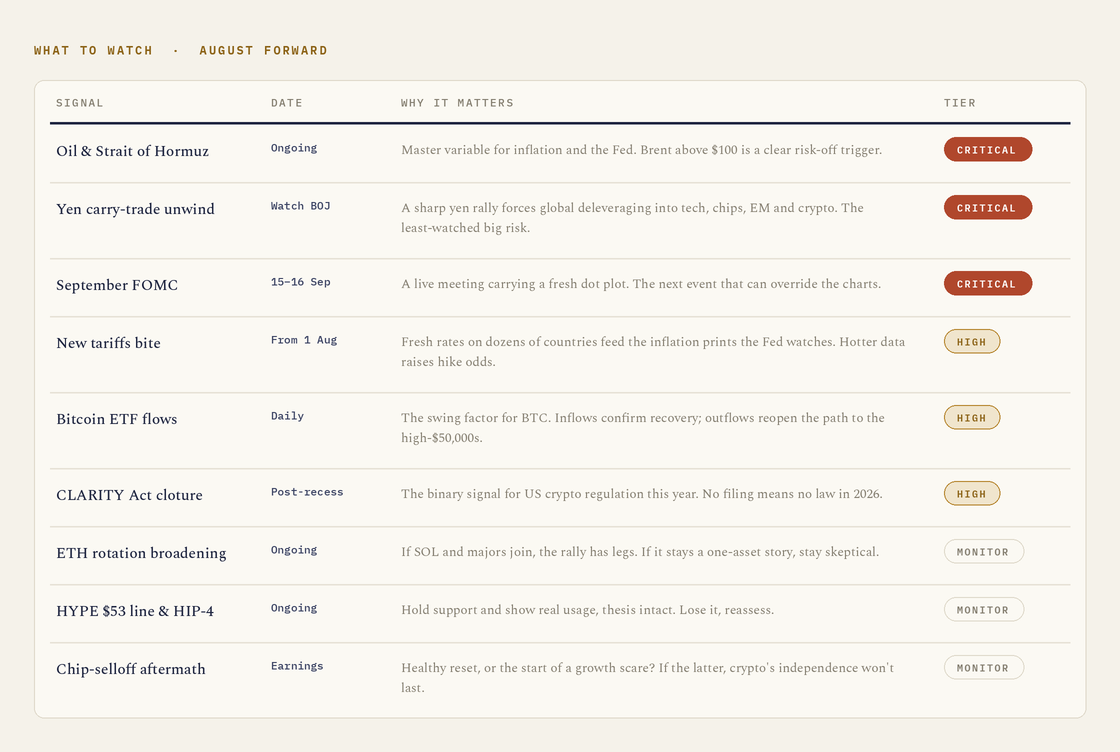
- The yen is the hidden trigger. A sharp move in one currency could force a synchronized selloff across tech, crypto, and emerging markets. It is the single macro variable worth watching this month.
- The crypto rally was a relief bounce, not a breakout. One asset, thin flows. Position for a choppy range, keep dry powder, and don't mistake a green month for the all-clear.
The Fed set the tone
Takeaway: stop planning for rate cuts. They are not coming this year.
The Fed held rates at 3.50–3.75% on 29 July, but the vote was 9 to 3, with three officials wanting an immediate hike. The chair is now Kevin Warsh, a hawkish Trump appointee who calls inflation "a choice." Markets now price hikes, not cuts.
For you: if you are raising capital, managing a treasury, or timing a big spend, assume money stays expensive deep into 2026. The free-money era that built the last cycle is over for now, and any plan that secretly depends on it needs rethinking.
Why the Fed can't cut
Takeaway: two forces are keeping inflation hot and the Fed's hands tied.
Oil: the US-Iran war has largely closed the Strait of Hormuz, the biggest supply disruption on record, and Brent is up about 20%. Tariffs: a fresh US round hit around 1 August, pushing the average effective rate near 13.5%. Jobs: June payrolls badly missed at 57,000 versus 115,000 expected. Hot prices plus a cooling job market is the stagflation setup nobody wants.
For you: if your business touches imported goods or energy, cost pressure is not easing soon. Price and plan accordingly.
The yen is the quiet fuse
Takeaway: this is the most important thing on the board, and almost nobody is watching it.
The yen hit a 40-year low, with USD/JPY above 163. For years the world has borrowed cheap yen to buy higher-yielding assets everywhere, including crypto. That is the carry trade, and it quietly funds a huge share of global risk-taking. Japan has spent tens of billions trying to prop up the yen with only brief relief, and on 30 July it suddenly jumped 2.6%.
For you: if you hold risk assets or run a treasury, a sharp yen rally can force a rapid, everyone-at-once unwind that spills straight into tech, crypto, and emerging markets. It is the same mechanism that jolted markets in 2024. This is the fuse. Watch it above everything else.
The rotation: out of chips, into crypto
Takeaway: money is fleeing the AI trade and crypto caught the spillover. Don't mistake that for strength.
For the first time in 2026, capital left AI hardware and moved into digital assets, led almost entirely by Ethereum. But ETH ETF flows were actually negative in the final week, so the move rode on-chain buyers and corporate treasuries, not fresh institutional money. A narrow base is a fragile base. Meanwhile over a trillion dollars in chip value vanished on real triggers: Meta selling surplus compute, DeepSeek reportedly building its own chip, and capex wobbles at SK Hynix and TSMC, much of the pain in Asia's supply chain.
For you, especially if you are building a career: attention and capital are rotating away from the AI-infrastructure frenzy. Where the money moves, the jobs and the opportunities follow. This is an early signal worth tracking.
Spotlight: Hyperliquid
Takeaway: the rare crypto business with real, provable revenue, now facing its first real test.
Hyperliquid crossed $1 billion in cumulative revenue and routes almost all of its trading fees into buying back its own token, a genuine flywheel rather than a story. HYPE cooled from its June record to the $53 to $59 range. The threat is not the market, it is regulators: Singapore's MAS flagged it, and US exchanges asked the CFTC to review its products.
For you: this is the clearest live example of what separates a real crypto business, revenue funding buybacks, from hype. It is also a reminder that in this space, regulation, not competition, is usually the real tail risk.
Regulation: still not law
Takeaway: US crypto rules remain guidance, not statute, which keeps big money cautious.
The CLARITY Act, the furthest-advanced market-structure bill in US history, stalled in the Senate and will likely miss its 2026 window. Most tokens are classified only by SEC and CFTC guidance, which any future administration can undo without a vote. Stablecoins are the exception, already covered by law.
For you: if you are building or allocating, do not treat today's rules as permanent. The ground can still move under you.
Security: the threat moved from code to people
Takeaway: your keys and your team are now the weak point, not the smart contract.
July saw about $210 million stolen across roughly 30 hacks, and the first half of 2026 set a record for the number of incidents. The biggest single loss was the Coldcard drain, about $70 million, from a flaw in Coldcard Mk3 wallets on firmware 4.0.1 through 5.0.3. North Korea-linked groups took roughly two-thirds of stolen funds, increasingly through compromised keys and social engineering rather than code bugs.
Act on this: if you hold bitcoin on a Coldcard Mk3 on that firmware, move it now. And for anyone serious, signer discipline and operational security now matter more than a contract audit.
Our read
We usually just report what we see. Here is our actual call.
We are not positioning for a new bull market, and we don't think you should either. Two forces set the board and both point the same way. A brand-new Fed chair has every reason to build his anti-inflation reputation early, so cuts are off the table. And Japan is fighting a currency battle it cannot win on fundamentals, which leaves the yen a loaded spring. When the two most powerful players are cornered into the same move, tight money and a fragile yen, the base case is not up and to the right. It is a choppy range with a fat downside tail.
So here is what we are doing: treating this rally as a range trade, not a breakout. Keeping dry powder. Respecting the downside. And watching the yen above everything else, because it is the one variable that can turn a slow grind into a fast repricing. A green month for Ethereum is not the all-clear. Right now, patience is the edge.
Market intelligence for independent decisions, not financial advice.
Comments ()