Tokenization Explained.

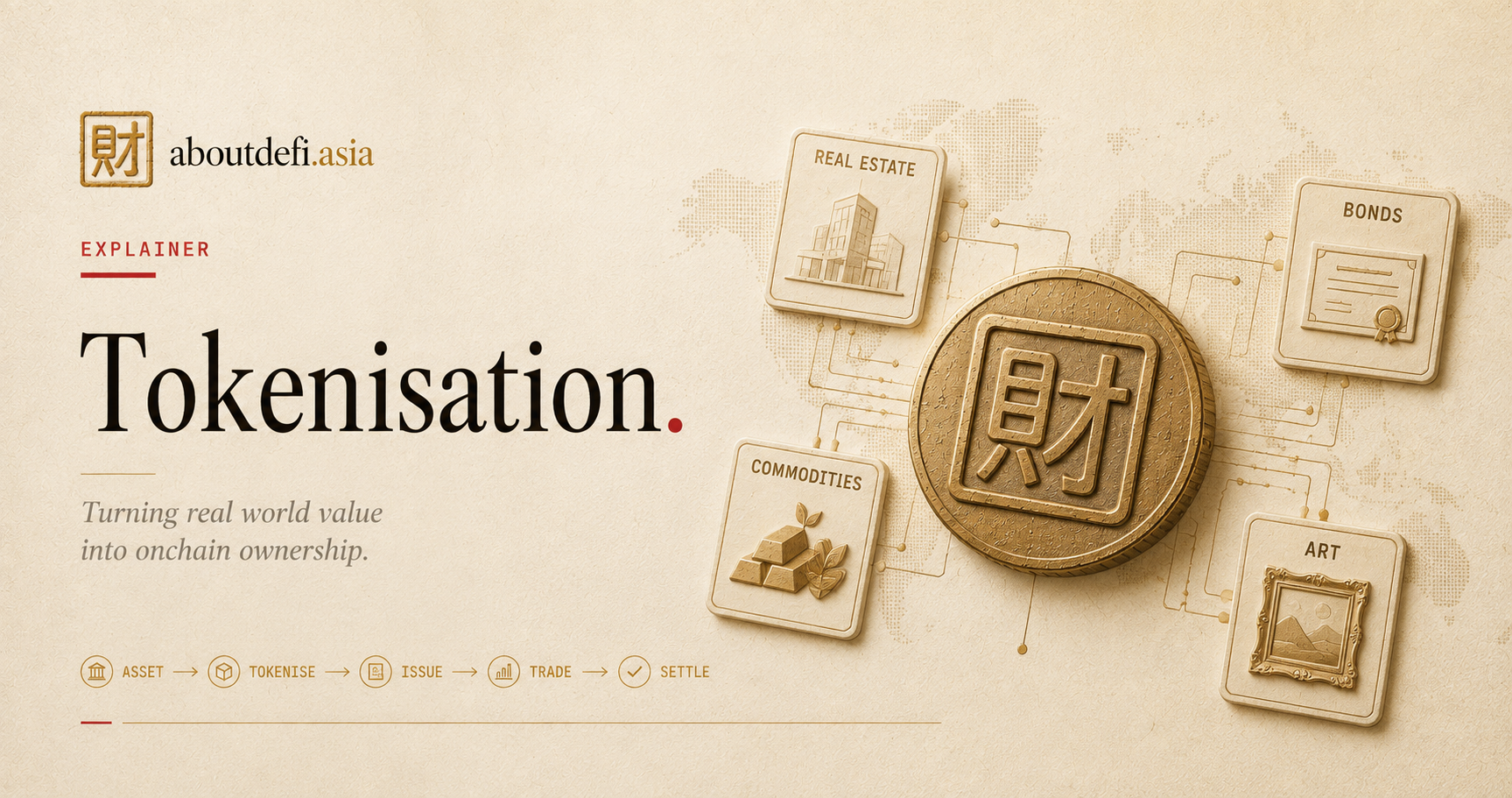
You already own a tokenized asset. You just call it a stablecoin. Here is what the word actually means, and why it lands differently from where we sit.
If you only read this
- Tokenization means trading the real thing, a share or a dollar or a gram of gold, for a digital claim on it that moves any hour and settles in seconds. Picture a coat check. You carry the ticket. The coat waits in the back.
- You already do this. The USDT in your wallet is a tokenized US dollar, and there are roughly $183 billion of them (August 2026). Stocks, bonds and gold are the same trick applied to bigger coats.
- Whether any of it is safe comes down to one old, boring question: does the issuer actually hold the real asset, and did they print exactly one ticket for it. Everything else is decoration.
Start at 2am.
You are in Singapore, or Kuala Lumpur, or Jakarta, and you decide you want to own a piece of Nvidia. Under the old way, here is what that takes. You open a US brokerage account. You wire dollars across a currency you do not earn in. You wait for the New York market, which opens while you are asleep and runs roughly 9:30pm to 4am your time. You place an order that fills in a blink but does not actually settle until the next business day. And at the end of it, you own a share that lives inside a chain of custodians with your name nowhere near the certificate. You are a line in someone else's ledger, three intermediaries deep, trading in the dark.
None of that friction is about Nvidia. It is about the distance between you and Nvidia. The time zone, the broker, the settlement lag, the currency, the paperwork. For a reader in Asia, that distance has always been the real cost of owning anything American.
For you: the tax you pay is not fees. It is access. The asset was never the hard part.
The part you already solved
You have been routing around this for years without a name for it.
Look at your wallet. The USDT sitting in it is a tokenized US dollar. Someone took a real dollar, parked it in a reserve, and handed you a digital claim on it. That claim moves 24 hours a day, crosses a border in seconds, and does not care that a bank in New York is closed. You did not need a US bank account to hold it. You did not wire anything through three intermediaries.
So you already own a tokenized asset. You have owned one for years. You just called it a stablecoin and never thought of it as the same idea. It is exactly the same idea.
So here is the actual definition
Tokenization is a coat check.
You walk into a venue and hand over your coat. In return you get a small paper ticket. The ticket is lighter than the coat, you can pass it to a friend across the room in a second, and whoever holds the ticket can walk up and claim the coat. The coat itself never moves. It hangs in the back the whole night.
That is the entire mechanism. The coat is the real asset: the share, the dollar, the bar of gold, sitting in a reserve. The ticket is the token. When a new coat comes in, the cloakroom writes a new ticket. When someone collects their coat, the cloakroom tears the ticket up. One coat, one ticket, always.
The industry has intimidating words for those two acts. Writing a new ticket is called minting. Tearing one up is called burning. Strip the jargon and it is a cloakroom writing and tearing tickets. That is all "mint" and "burn" have ever meant.
The only question that matters
Trust the cloakroom, not the ticket.
A ticket is only worth something if the coat is really in the back, and if the cloakroom did not quietly print three tickets for the same coat and hand them to three different people. Everything you ever need to ask about a tokenized asset collapses into those two things: is the real asset actually in the reserve, and is there exactly one token per unit of it.
I have spent my career on the institutional side of this, across custody, settlement, and the exchanges that sit in the middle. The lesson that survives every cycle is this: the unglamorous plumbing is not a footnote to the product. Who holds the keys, who is allowed to mint, who independently checks the reserve and how often. That plumbing is the product. When a tokenized asset breaks, it is almost never the blockchain that failed. It is the cloakroom.
For you: do not evaluate a tokenized asset by its technology. Evaluate it by its issuer, its reserve, and who audits it. Same as you would a bank.
Why it does not stop at dollars
If it works on a dollar, it works on anything with a clear owner and a clear price.
A dollar was just the easiest coat to check first. The same mechanism now wraps US stocks (Backed's xStocks, Dinari's dShares), physical gold (Tether Gold, PAX Gold), and US Treasury funds (BlackRock's BUIDL). Different coats, identical cloakroom.
And it is no longer a rounding error. Tokenized stocks went from about $2 million in mid-2025 to roughly $2.5 billion by mid-August 2026, now around 6 to 7 percent of a $38 billion tokenized-asset market (rwa.xyz, 13 August 2026). The more telling shift is who is doing the minting. The big exchanges you already use are moving from listing other people's tokens to issuing their own, because whoever runs the cloakroom keeps the economics. That is a quiet, important change, and we will keep tracking it.
Why this reads differently from where we sit
For New York, this is convenience. For Asia, it is access.
To a reader in Manhattan, a tokenized stock is a mild upgrade. They already have a broker, the market opens over morning coffee, and they get paid in the currency it trades in. Tokenization saves them a little friction.
From here it is a different object entirely. It is the first time the US market is reachable without a US broker, awake at a civilised hour, in a size you choose down to a few dollars. That is not a feature. That is the removal of a tax you have quietly paid your entire investing life. This is why the story matters more in Asia than in the place it was built for, and why almost nobody is writing it that way.
But look underneath the floor before you celebrate. Almost the entire tokenized stack out here settles in one currency: USDT. Your tokenized Nvidia is priced in it. Your dividend-equivalents arrive in it. Your tokenized gold is quoted in it. That means one private company's dollar now sits beneath a fast-growing slice of Asian portfolios. Tokenization did not remove the middleman. It swapped a chain of small ones for a single very large one, and most people out here have not noticed which middleman they just started trusting.
For you: the risk in this market is not the tokens. It is the currency and the reserve underneath every one of them. Watch that layer, not the ticker.
Our read
Tokenization is not a crypto story. It is a distribution story.
Everything it does reduces to one thing: it collapses the distance between an asset and whoever wants to own it. For Asia, that distance was always the highest cost in the room, which is exactly why this lands harder here than in New York.
So own the ticket. It is genuinely a better way to hold the coat. Just never lose sight of two questions: who is holding the coat, and what currency will they hand you when you come to collect. The oldest technology in finance was never the blockchain. It is trust. Tokenization does not remove it. It relocates it, and your only job as a reader is to know exactly where it moved.
A note on where I sit: I work on the institutional side of this industry in Asia-Pacific. I have kept my own firm and its products out of this piece deliberately. Every asset and issuer named here is on the public record, and every figure is dated to its source so a reader two years from now can check whether it held up.