
AAVE Explained

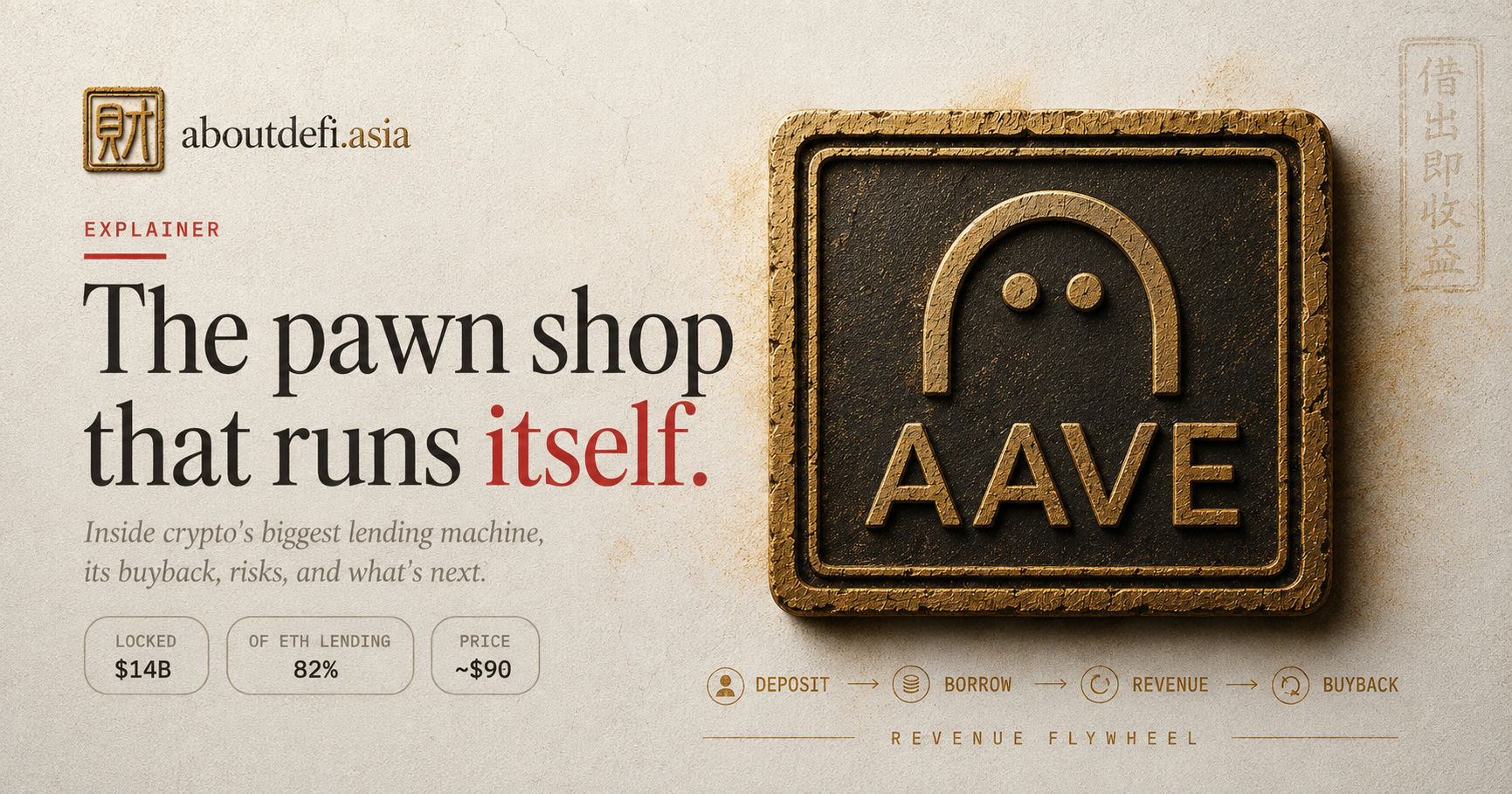
To understand Aave, forget the jargon and picture a pawn shop. A strange one: it runs itself, never closes, and has no staff. You walk in with something valuable, lock it in the vault, and it instantly hands you cash against it. No credit check, no manager, no paperwork. That is Aave. And this year it did one thing that changed why people actually want to own its token.
If you only read this
- Aave is the biggest lending machine in crypto, a pawn shop run entirely by code. It carries roughly 82% of all the money borrowed on Ethereum. When other apps want to offer lending, many just plug into Aave. It's the plumbing.
- It makes real money, and since June it uses that money to buy back its own token every day. That's the new reason to hold AAVE: it's starting to behave like a cash-flow business, not just a governance coin.
- But respect the downside. The buyback is smaller than the hype (about 2% of the token's value a year, not a price floor), the fees shrink in a bear market, and one bad loan already wiped billions off the platform once this year.
What Aave actually is
A pawn shop for crypto, with every rule baked into the machine.
You lock up crypto as collateral, and the shop lends you cash against it. On the other side, people deposit their spare cash into the same vault to earn interest from the borrowers. The interest rate, and the moment your collateral gets auto-sold if its price falls too far, are written into the software and happen automatically. That automatic sale is the whole trick: it's how the shop can safely lend to anonymous strangers without ever needing to trust them.
It is the biggest one of its kind in the world. Aave carries around 82% of all the money owed on Ethereum and about 60% of the entire crypto lending market. Rivals mostly route around it rather than replace it. It is the plumbing everyone else builds on. (Snapshot: about $14 billion sitting in the protocol as of early August. These numbers move daily.)
How it makes money
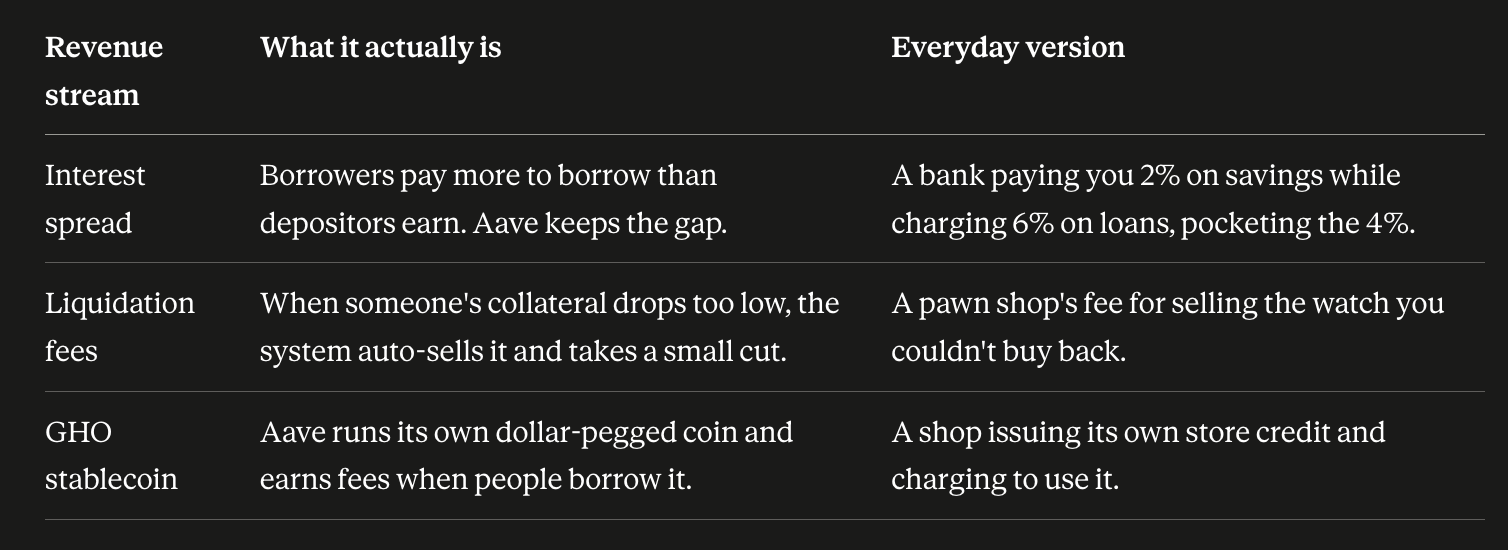
Together these throw off somewhere around $400 million a year in gross fees. One honesty flag, because it matters: "fees" and "money that reaches you as a token holder" are not the same number. The amount that actually flows back to holders is a fraction of that headline. Don't anchor on $400M as your money.
Why you'd actually own the token
Since June, Aave automatically spends some of its revenue buying back its own token. That's the whole bull case.
This is exactly what Apple does when it buys back its own shares: fewer tokens exist, and there's a steady buyer sitting in the market. Both support the price. Since June 27, 2026, this runs automatically, pulling roughly 292 AAVE off the market every single day, and it's now hardwired into the code rather than something a committee votes on each time.
Two smaller reasons stack on top. You can lock up your AAVE to help backstop the system and get paid a yield for it, a bit like a dividend while you wait. And about 96% of all the AAVE that will ever exist already exists, so unlike most coins there's almost no new supply quietly diluting you in the background.
In one line: AAVE is a bet that the lending business keeps earning, because that money now flows back to the token.
The honest reality check
The buyback is a tailwind, not a shield.
The budget was actually cut this year, from about $50 million to $30 million, as borrowing revenue fell. Against a roughly $1.4 billion token, $30 million a year is about 2% of the value buying itself back. Helpful, but in a real crash that buying gets swamped in a day. And the flywheel runs in reverse: if borrowing dries up, fees shrink, the buyback shrinks, and your "steady buyer" gets weakest exactly when you'd want it strongest. A big chunk of AAVE's daily price is still just riding Ethereum and general crypto mood, not fundamentals.
Who it's up against
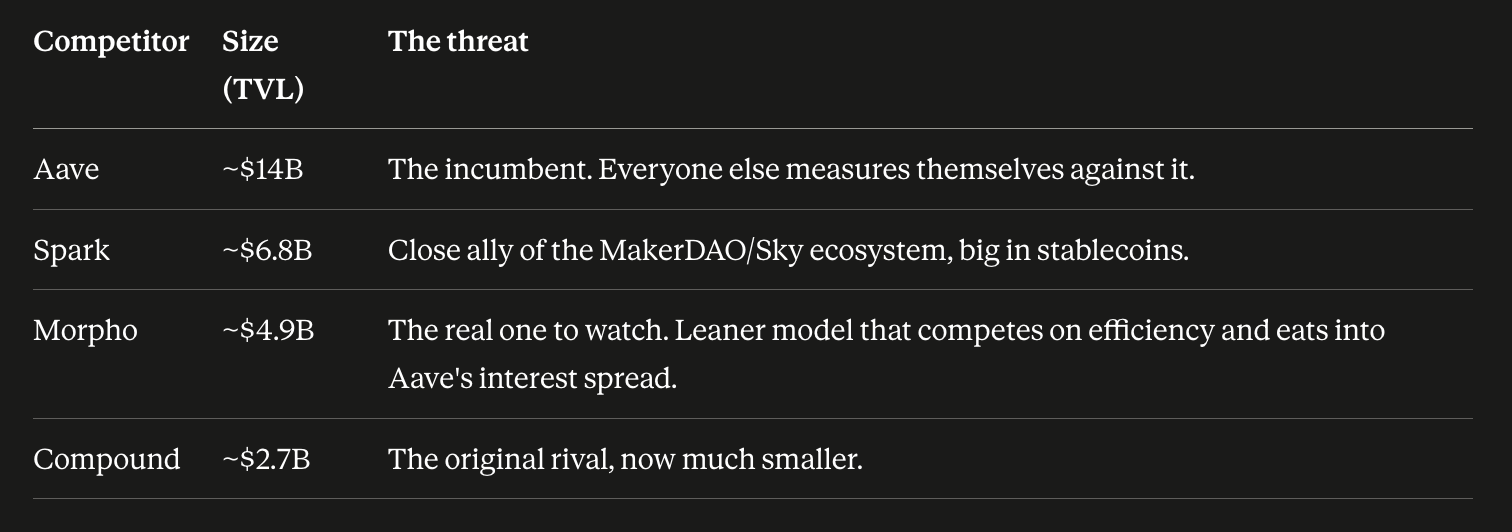
Aave leads its category by a wide margin. The one real threat is Morpho, a leaner competitor that wins on efficiency and can quietly squeeze the interest spread Aave lives on. Morpho's own founder frames it well: Aave is the bank, Morpho is the infrastructure the banks run on. That's the competitive risk in a single sentence.
What's happened lately
The cloud lifted, the growth is shipping slowly, and there's one scar to remember.
The regulatory overhang is gone: the SEC closed its multi-year investigation into Aave in December 2025 with no charges. The new V4 engine went live on a second blockchain, Avalanche, in July 2026, though the big institutional "real-world assets" business everyone's excited about is still roadmap, not live.
And the scar. In April 2026, an attacker used about $292 million of effectively fake collateral to borrow real money from Aave, leaving roughly $196 million in bad debt and knocking about $6.6 billion off Aave's deposits. Aave's own code was never broken. That's the whole lesson: Aave's real risk isn't a hacker cracking the code, it's bad collateral walking in the front door.
For you: if you're building or allocating in Asia, Aave is increasingly the backend other products plug into (savings features, stablecoin yield, tokenized real-world assets). Worth understanding as infrastructure, not just a coin, because you may end up using it without the "Aave" label ever showing.
Our read
Bull case. You're buying the clearest cash-flow business in DeFi at roughly half its recent peak, with a genuine moat, almost no dilution, and a value-return mechanism that was just made semi-permanent. If borrowing picks up and the real-world-asset business delivers, the earnings and the price people pay for them can rise together.
Bear case. Revenue is cyclical and shrinking right now, the buyback is smaller than the hype suggests, a leaner rival is pressuring its margins, and a single bad asset already vaporized billions in deposits once this year. Under the "blue chip" label, it's still a high-beta bet on crypto activity.
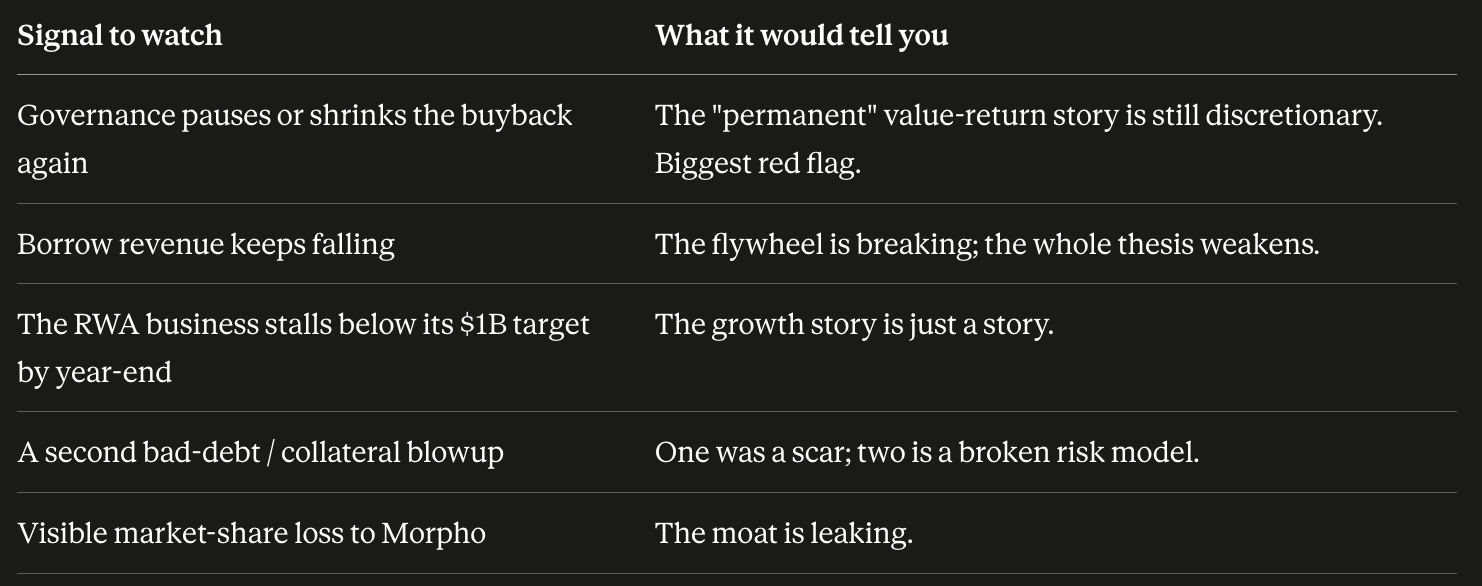
The one-sentence version: AAVE is a stake in a real, profitable lending business whose profits now flow back to you, but it's a bet on that business growing, not a bond with a guaranteed payout.
Market intelligence for independent decisions, not financial advice.